Thursday, June 17, 2010

Getting the Most Out of Summer

There is a certain irony in the timing of this new sermon series we're beginning this Sunday. It's a series about rest, sabbath, and stuff I mention below. It comes, however, at a time of extreme busyness. At Cedar Hills we're cleaning up after some significant water damage and we have a workday planned (this Saturday at 9 AM - hint, hint) to sort junk and toss stuff into a huge dumpster. Along with the cleanup we're gearing up for Vacation Bible School which starts on June 27th - just a week away. Rest seems out of the question.  Most of us constantly feel that sense of "There's just too much to do!" far too often.

But maybe that's God's point.

There are always more things to do. Sometimes those things press in so urgently that they simply must be done. But life can't be filled with what Charles Hummel calls, "The Tyranny of the Urgent." Not all the time. God knew such things about us when he planned the cycles of the body. He created us to need sleep and for our slice of the world to go dark for a portion of each 24 hours so we would ... stop. He hard-wired us in such a way that those who simply refuse to rest and play will eventually break down. It seems important to God, then, that we get this right.

So even in the middle of urgent things that are pressing in upon you and me, we're going to start this little message series. I hope it helps take away any misplaced guilt about taking time to slow down, rest, worship, remember God, spend time with family. Recharge.  There are many different kinds of retreat or rest are mentioned in the bible. There is the overall concept of Sabbath - which means “cessation” in the Hebrew. There are also great celebrations and feasts, prayer retreats, and other times when people of the bible stopped doing their regular work. This three-part message series will study different rest periods and look at the reasons for them.

So listen to God's wisdom and ... take a break! As if for us personally, the Wall Street Journal has an article today (June 17, 2010) entitled, Why Relaxing is Hard Work. Take a look at it (I snagged their picture - above - too...) and you can even check out their "Are you a workaholic?" quiz linked in the article.  Then, for a little over an hour on Sunday, we'll all simply . . . stop . . . and begin to consider God.
- Curtis

Friday, May 28, 2010

Chained for Good: Jeremiah

I sometimes wonder what the dedicated prophets of the bible would have to say about some of the big name preachers today.  Consider some of the top selling books and audio CD's by one of the most famous preachers in the USA today.  His works include:
  • It's Your Time: Activate Your Faith, Achieve Your Dreams, and Increase in God's Favor
  • Become a Better You: 7 Keys to Improving Your Life Every Day
  • Good, Better, Blessed: Living with Purpose, Power and Passion
  • Living in Favor, Abundance and Joy 
  • Living The Joy Filled Life (Six Easy Steps To Living A Life Of Victory, Abundance And Blessing)
While I'm certain he has some very good things to share, I can't help but wonder how Jeremiah would respond to advice about Six Easy Steps to Living a Life of Victory.  Jeremiah spent a good chunk of his life being hated by his own people, persecuted by those he was sent to save, and tortured for doing exactly what God called him to do.   He's known as the weeping prophet.  

Imagine a conversation, then, between Jeremiah and a Big Name Preacher (BNP) from today. . .
----------------
BNP: Jeremiah, my friend, you're not living a victorious life.  Look at you.  You're sad, you're unsuccessful, you're a mess.   But I can help.  Let me share with you the easy secrets to living a life of victory. 
JEREMIAH:  Really.  Do tell. 
BNP:  Clearly you're doing this prophet thing all wrong.  You'd have favor, abundance and joy if God were pleased with you!   You need to activate your faith! 
JEREMIAH:  I'm about to activate you.  
BNP:  You see that?  That's anger.  Let God can turn your anger to action;  your sadness to sufficiency; your trials to triumphs!  
JEREMIAH: You've got a knack for catchy phrases.  
BNP: Thank you.  I'm writing a book about that. 
JEREMIAH:  Of course you are. . .   But here's the thing.  God told me, the day he called me, that my path with him would be terribly hard.  That my work is to warn people of God's coming wrath.  This is what he's called me to.  
BNP:  Of course he didn't.  You misunderstood.  He doesn't want anyone to be unhappy.  He wants to turn your inner Eeyore into a Tigger!  It's right here in my book, "Living in Favor, Abundance and Joy."  
JEREMIAH:  My inner Eeoyore is about to kick your . . . never mind.  I have to go.  Someone wants to throw me into a muddy cistern.  (walking off)
BNP:  Read chapter 3 - God Has More In Store!  
JEREMIAH: (muttering) What I wouldn't give for a little fire and brimstone right now. . . 

----------------

Truly, Jeremiah had a tough row to hoe.  So tough, that at one point he curses the day he was born (Jeremiah 20:14) and wished it hadn't happened at all.  But in the end, he stuck with the thing God had given him to do.  He realized that life wasn't all about him, but about God's purposes and Kingdom.  That's a huge thing to remember.
It isn't all about Me.  

A good friend reminded me of that this week, when I was lamenting some of those tough rows God gives.  We'll see what else Jeremiah has to say to us this week in worship.
- Curtis

Friday, May 21, 2010

Chained for Good: Peter

I think it must have been very confusing to be an early Jesus follower.  It's confusing enough for us sometimes, but these guys had to be constantly saying, "Huh?  What's God doing now,  for Christ's sake?!" (and, if they used that phrase, they really meant it - not like people do nowadays, who say it lightly and defame the name of Christ - not for his sake at all...but I digress).  It would have been confusing because God never seemed to do things the same way twice, even when it would have been quite nice if he had.

Take the Big Three Apostles, for example.  Peter, James and John.  These guys were Jesus' BFF's.  We don't want to think about Jesus having favorites, or if he does we'd like to think it might be us.  But the truth is, Jesus always chose these guys to go do stuff with him that no one else got to do.  They got to go into the house when Jesus raised a little girl from the dead.  They were the ones to go up on the mountain and see him transfigured in glory.  They were the ones he asked to pray with him in the garden before was carried away and executed.  Again, if I had been there with Jesus I would have been the obnoxious one saying, "Pick me!  Pick me! Oo, oo, pick me, Jesus!!"  He never would have.  He always picked Peter, James and John.  Which makes what happens to James in Acts 12 extra confusing.  If you read it quickly you might even miss it because it's like a little footnote to what comes next with Peter.  But read what happens to James, one of the Big Three friends of Jesus,
It was about this time that King Herod arrested some who belonged to the church, intending to persecute them.  He had James, the brother of John, put to death with the sword. (Acts 12:1-2)
Poof.  That's it.  James is done.  There's nothing more said of him.  Yet back in Acts 5, all of the apostles were apparently rounded up and imprisoned.  They were put in jail by the High Priest and his thugs, but during the night an angel came and sprung them free.  So when James again ends up in prison in ch 12, he might have thought and prayed, "Okay, Lord!  You know me, your buddy James! Spring me free again!"  It didn't go that way, sadly.  See how confusing following God can be?  And dangerous.  

Peter is the next one tossed in the clink (ch 12).  Herod sees how happy the Jews are to have James sliced open, so he grabs Peter and puts him in stocks too.  I wonder what Peter was thinking the night before his trial and probable execution?  The scripture doesn't say.  He had experienced miracles and he'd felt God's silence when prayers for deliverance were uttered.  Just because we ask God to free us from a prison, it doesn't always mean he will.  Which leads us back to the beginning:  Following God is certainly confusing.  A dangerous adventure.  The funny thing is, I don't think Peter or even James would have wanted it any other way.  They were content with putting their lives completely in God's hands.  For Christ's sake. 

This Sunday is both Pentecost and, at CHBC, Camp Sunday.  So wear campy, red stuff!  The message will look at Acts 12 and how Peter sensed the Spirit's peace and power, even in prison.  
- Curtis

Friday, May 7, 2010

Chained for Good: Jonah


A long time ago I remember hearing a preacher tell a story about a guy in the late 1800's, in English waters, who fell off a ship called the "Star of the East" and was swallowed by a whale.  According to the story, the poor guy had very light skin the rest of his life as a result of the whale's gastric acid which bleached him.  The story was told to show that yes, in fact, something as amazing as Jonah's story could be true.  The unfortunate guy who was whale chum was named James Bartley.  The story (see one version here) has been told in many sermons through the years and is still a common one today for preachers who desperately seek a hook to make the more amazing bible stories a bit easier to swallow (insert groan here).

The trouble is, the Bartley story isn't true.  The best that historical sleuths  have been able to come up with is that the story was fabricated soon after an actual whale was beached and died near the shore town of Gorleston England.   The thirty-footer was rather famous and lots of stories circulated about it - including the Bartley story.  Eventually, an ambitious taxidermist stuffed the whale and it was displayed in the London Westminster Aquarium.  But James Bartley was not found inside.

I'll leave it up to you to decide whether the Jonah story is historically accurate or mythic.  I don't have a problem with it being true.  If God can create big fish -  and you and me - out of a single cell and puff his breath into us to make us alive, then it can't be that hard for him to give a fish a hankering for a Jonah snack and keep the rebel alive for a few days.  "The earth is the Lord's and everything in it" the Psalmist says.

What's odd to me is that we squabble over the truth of whether Jonah could live in a fish, but we don't blink an eyelash at how the Ninevites repsond when Jonah shows up.  Jonah delivers the "turn or burn" message and they . . . turn.  Huh?  The arch-enemies of Israel who follow a smorgasbord of other gods drop everything, fast, pray, repent and turn to God because some reluctant fishy smelling loudmouth tells them they're going to fry if they don't turn to God?  Seriously?  How great of a miracle is that?  That's a story that we should cause us to think, "Wow, what sort of a God is this?"

On Sunday we'll think about such amazing truths and hoist more treasure from the depths of Jonah's tale.  In the meantime, Netflix has the VeggieTales version streaming online . . .
- Curtis

Friday, April 30, 2010

Chained for Good: John the B

It's been awhile since there's been time to write here, but we're in the middle of a 7 part sermon series about biblical characters who were imprisoned.   I have to mention, before I write anything else, that I absolutely KNOW you're going to love the video intro to this week's message.  If you've been in worship, you know that each message in this series starts with a story about an unusual prison.  This week's is one of the best - really fun (which isn't the way you might normally describe prison stuff).  But I don't want to spoil it for you, so you'll have to show up if you want to see the prison story I'm going to share this week.  It's great!

Anyway, this is week three in the Chained for Good series, and we're taking a look at John the Baptist who is an interesting guy.  (Matthew 11:1-19)


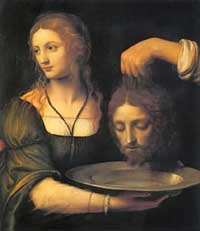
John's ministry is fairly short-lived and yet Jesus describes him as the greatest of all the prophets.  He has an amazing ministry of proclaiming the coming of the Messiah and getting people to look at their lives.  But soon after Jesus comes on the scene, John gets tossed in jail for daring to tell Herod that he was an adulterer.  Instead of being rescued as some of Jesus' disciples were later, he comes to a grisly end when his head is lopped off to please a bratty dancer (makes a nice painting though, doesn't it?).  

If you've ever believed that a radically faithful life lived for God will lead to success and comfort, this guy torpedos that idea.  What does John have to teach us then?  That's what we'll discover Sunday.
- Curtis

Thursday, March 11, 2010

Extreme Makeover

I have a memorial service this week for a wonderful woman who lived 96 full years:  Ida.  The last time I saw her was on Friday when she was, quite literally, on her death bed.  Her body was rounding the final turn, but her mind was still sharp.  The visit consisted of a scripture, a prayer, and holding her hand for a few minutes.  She dozed and breathed heavily.  She smiled.  Then she said, "Well, thank you for coming.  It's been delightful!"  I knew that meant, "Time to go, preacher man!"  But I also had a feeling she was saying that this life had been delightful.  Even in those last moments she was dignified and grateful.  That's a beautiful lesson.  I laughed and she smiled once more. We said our goodbyes on this side of the new creation.  Three days later she went home.


A central theme all the way through 2 Corinthians is about Paul’s awareness of his own mortality.  He was probably in his mid to late 50's when he wrote the letter, but he knew that there were plenty of people who wanted him dead.  Life wasn't exactly safe for him.   He writes about, “Treasure in jars of clay...being crushed...outwardly wasting away...earthly tent destroyed....”  Yet his awareness of death is always framed within the context of hope in the resurrection and knowing that this life is not all there is; in fact it is a small part of all that life is for the believer.  


We are in the infancy of our lives.

Try and think back to when you were leaving elementary school and heading off to middle school.  For most, that’s 5th grade, 6th for some.  Those first 5-6 years of school, at that point in your short life, seemed like forever.  As a 5th grader, you looked back at those little 1st graders and thought, “They’re so little!  They’re so young and silly. I’m so big and smart now.”  And then you re-lived a similar experience in 8th grade as you looked back on those punky little 6th graders; yet again when you were a senior in high school and you saw those pimple faced freshman walking, deer-in-the-headlight style, down the halls.  Those experiences continue, perhaps with less frequency, throughout our lives when we end one stage and begin another.  College...our first job....marriage....raising children...taking them off to their first day of elementary school.
Isn’t it likely, then, that we’ll find something similar at the end of this life as we step into the next?  I suspect so.  Once we’re with Christ, stepping into a new stage of life, we’ll look back on the decades we’ve spent in this “earthly tent” (2 Corinthians 5:1) and say, “Wow.  What a child I was! Look at all that lies ahead.  I wonder what this new stage will be like?” 

When I was a child, I talked like a child, I thought like a child, I reasoned like a child. When I became a man, I put childish ways behind me. Now we see but a poor reflection as in a mirror; then we shall see face to face. Now I know in part; then I shall know fully, even as I am fully known.” - 1 Corinthians 13

Paul’s whole point, in 2 Corinthians 5 (our sermon passage this week), seems to be, “Don’t waste the time you've been given in this body.  Spend your time on eternal things, meaningful things."  The very most meaningful, to Paul, was reconciling people to God.  And that’s the topic we’ll be looking at for  this week’s message.  How does this long-term, eternal perspective of life - and other people - change what we focus on now?  How does it change our view of people and their sins, hurts, troubles?
- Curtis

Saturday, February 27, 2010

Decisions, Decisions . . .

It's Lent already.  That's the 40 days leading up to Easter which really doesn't seem like it should be as close as it is.  I'm beginning some sermons that don't technically qualify as a "sermon series" but there is a common string that winds through the next three Lenten sermons.  That common string is "Decisions."  Life is full of decisions small and large.
"Will I get out of bed today? .... Oatmeal or cereal?" 
"Phone call or email?"
"Should I quit my job?" 

I'm suspicious that, like the guy who opts for junk food instead of something healthy, we fill up on relatively unimportant choices and neglect the truly important and less numerous decisions.  We ponder what TV show we'll watch, whether to buy a new gizmo and fifty other meaningless choices each day, but we don't bother thinking about whether there's any significant purpose to the day we just completed.

The problem with such a pattern of small choices taking precedence over important decisions is obvious:  Life feels meaningless.

What if the solution to this problem is very simple?  Could it be that there are perhaps just two or three decisions that require our focus?  And, once we honestly make these genuine decisions and live daily in concert with what we've chosen, then everything else will fall into place rather well.

Over the next few weeks we'll look at what these two or three decisions might be, and how they impact every other aspect of life.  Check out the weekly question above - I 'd love to read about some of the decisions you have made this week.
- Curtis

Friday, February 19, 2010

We've Got the Power

A lot of times, when I read a bible passage, I blow through it as if I'm at a buffet.  I move right along, looking for the good stuff that tastes best: Morsels of the Word that encourage me, inspire me, comfort me - whatever it feels like I want at the moment.  I doubt that's a good way to read scripture.  What's missed are the most nutritious parts of the biblical meal.

There's a little appetizer in Ephesians this week that is easily passed over.  It's this:
And he made known to us the mystery of his will according to his good pleasure, which he purposed in Christ, to be put into effect when the times will have reached their fulfillment—to bring all things in heaven and on earth together under one head, even Christ. 
Ephesians 1:9-10
Did you catch that?  The "mystery of God's will" is that God is in the process of bringing all things on "heaven and earth... together" under Christ.  In other words, that's where everything is headed.  This world isn't going down the tubes.  It might look that way, but it isn't.  God's bringing heaven and earth together and that means that his recreative power is constantly being released all over the place.  It's kind of funny that we have a hard time seeing that since it goes on all around us and we take it for granted.  Just this week here in Oregon we had a super nice spell of weather and the blossoms started exploding on the cherry and plum trees.  Grass began to grow.  Leaves poked out of dead looking tree branches.  "That's just Spring," we say.  It's also part of the regeneration and recreation that God builds into nature. It's like he's tapping us on the shoulder and saying, "See? Heaven and earth are joining.  All things will become new."  Paul says the Spirit of God is the beginning of our own regeneration - part of heaven implanted into you and me, and yet there's more to come.

Back in Ephesians, after Paul points to this unification of heaven and earth, he prays that the "eyes of (our) heart may be enlightened."  Hmm.  That's different. Picture your heart with little plastic goggly eyes peering out between your ribs.  What are the "eyes of our heart?"

This week I'm finishing up our short series of messages on prayer by looking at this prayer of Paul's.  What strikes me most as we've studied some key prayers in the New Testament is how different they are than the way I normally pray.  I guess that shouldn't be so surprising - I'm no Paul or Jesus!  Yet their prayers are dramatically different than what most of us pray.  Part of that difference is due to them praying for many people, not just for an individual or a time constrained situation.  But their prayers are also different because they think differently; they have a larger perspective and a bigger view of what's going on around them.  In other words, it seems that reality is so much more real then mine.  The substance of Paul's prayer and what it means for our lives today is what we'll explore in the sermon.
- Curtis

Friday, February 5, 2010

Forgive us Our Sins As We . . . What?!

Have you been faced with . . . 
   * wanting to forgive, but the person who wronged you denies or minimizes their offense, or
     *  knew you needed to forgive but you didn't feel capable of it?
        
And have you . . . 
     * wanted to receive forgiveness, but it wasn't offered, or
       * received forgiveness when you knew it was immensely difficult to the one who offers it? 


In the Lord's Prayer, Jesus teaches us one of the hardest prayers for us to say with complete sincerity,
Forgive us our sins 
as we 
forgive those who sin against us


It's the "as we" that hits us between the eyes.  If we were just asking for forgiveness for ourselves - and sure, we could ask God to forgive those who sin against us - that would be one thing.  But he ties the two aspects of forgiveness together, 
For if you forgive men when they sin against you, 
your heavenly Father will also forgive you. 
But if you do not forgive men their sins, 
your Father will not forgive your sins.

What is there about un-forgiveness that short-circuits God's forgiveness for us?   Is it that grace, after all, is somehow earned - or perhaps withdrawn depending on whether we forgive others or not?  Or is there something deeper going on?  I opt for the second option and that's what we'll discuss in this week's message. 

I'll also be sharing a clip from a film that impacted me profoundly when I saw it recently.  It's called As We Forgive (trailer here), and it shares the true, contemporary story of Rwandans who were called to forgive those who participated in the genocide of over one million of their brothers and sisters in 1994.  If you've ever struggled to forgive something terrible, you'll want to see it.  If you need to sense God's forgiveness in new ways, join worship at CHBC this Sunday. 
- Curtis 

Friday, January 29, 2010

Soul Surgery (& Prayer)

This week we're starting a three week series of messages looking at prayer.  I'll just be straight-up here and confess that prayer has never come easy for me.  That's not to say that I neglect talking to God, which I do quite often through the course of the day.  But prayer is not something that comes easily to me like breathing, walking or craving a chocolate chip cookie.  Perhaps I have spiritual ADHD.  Prayer often feels like more effort than it's supposed to be.   The father of the Reformation, Martin Luther, supposedly said, “I have so much to do that I shall spend the first three hours (of each day) in prayer."  I can't really imagine that kind of daily prayer focus.  When I pray for more than about 20 minutes, I get irritated, bored, and doubtful.  I start thinking, right in the middle of talking to the Almighty Creator of Everything, "I've got things to do.  Gotta run!"  That's not what you want your pastor saying about prayer, is it?  


I suspect that there are a lot of other followers of Jesus who are like me.  Charles Spurgeon, an English Baptist preacher in the mid and late 1800's, preached 130 sermons about prayer.  Is it possible that Spurgeon preached about prayer so often because he knew it's hard for the average person to pray?  I long to be someone who can relate to/with God like Moses in Exodus 33,  "The Lord would speak to Moses face to face, as a man speaks with his friend."  How great would that be?  


The more I think and even (gasp) pray about my prayer problem, the more I've come to realize that it is my misunderstanding of prayer that's the real trouble.  Even though I know better, I still tend to pray as if it's all about me telling God what I think he should be doing.  I may couch my prayers in a respectful formula (ie, the old ACTS prayer recipe . . . A=Adoration, C=Confession, T-Thanksgiving, S=Supplication - ah! At last supplication where I get to what I want!), but the truth is, I see prayer as all about me.  That, I fear, is the real trouble with my prayer life.  And so that's part of the reason I decided to preach on the Lord's Prayer this week (on the left side of this blog you can see the other sermons coming up).   I figure Jesus must know how to do this prayer thing pretty well, so that when he teaches us to pray he probably knows what he's talking about.  I like how straight forward he is about prayer and that he says, "...don't babble like the pagans because it's really annoying to my Father..." (my paraphrase, but that's actually what Jesus says). 


In worship this week we will unpack this most amazing prayer and try to tear off most of our preconceptions and misconceptions, and get a clear view of what Jesus is teaching.  One peculiarly fascinating possibility is that Jesus' prayer had a lot to do with the Hebrew Exodus story as the Jews were delivered from Egypt.  Could the Lord's Prayer be a later development of praying through our own deliverance from the things that enslave us?  That's one possibility we might explore.  
- Curtis  


Friday, January 22, 2010

What's God Up To? Giving You a Great Body


I completed my first "spinning" class this morning.  Yes, "spinning" sounds like a class that teaches you how to spin around in circles until you puke.  In reality, it's a cycling class where you mount a bike like the one in the picture here and follow the leader of the class as they put you through an intense, varied workout.  It was a mere 45 minutes, accompanied by the DJ/instructor who spoke to us from her mic and played a variety of songs meant to inspire us.  "Sheesh how hard can this be?" I thought.  I used to ride almost every day and I even did a few triathlons many years ago . . . before my 19 yr old daughter was born.  "I'm in good shape, there's nothing to fear."   I thought.

I was wrong.

Things started off well, with the gentle instructor telling us to keep the resistance on the bike low and simply spin.

"I can do this" I thought.

Soon we entered Stage One - our first "hill" as we turned the resistance dial up a few notches and then rose off our seats as though peddling up an ever steeper hill.

"I might be able to do this" I thought.

Stage One, with varying degrees of difficulty, lasted 10 very long minutes.  The music, which was helpful to start with, began to annoy me.  When the first stage was over, we fell back into our seats and dialed down the resistance.  Heavenly.

Barely a minute later Stage Two began and this time we were coached to "dial it up" and "chase the van."  I couldn't see a van, which told me that it was way too far ahead and I shouldn't worry about chasing it.  But the testy instructor, who evidently could see the van, yelled at us to chase it while increasing the resistance.  We backed off for 15 seconds, then dialed it up for a minute, backed off for 15, dialed it up. . . you get the idea.  Sweat poured off my head, dripped down my face, and hung on the end of my nose until the salty droplets leapt to their demise on the spinning wheel below.  I tried to see how many of the drops I could get to fall directly on the wheel, hoping a wet, lubricated wheel would spin more effortlessly.

"What am I doing here?"  I thought.

After a brief low- resistance rest time, we entered the final challenge, Stage Three.
"Alright people!" the instructor barked, "This is it.  I want to see you work!  I want to see your hands on that dial; bump it up!  We're going to do 10 more minutes with 8 rotations; 10 seconds in your seats, followed by one minute on your feet peddling as hard as you can!  Ready, 3...2...1.... GO!"  The music blared a feverish country tune about a spurned wife, and we peddled furiously.

"Is it possible for a heart valve to simply tear wide open and rupture?  How long are those valves good for anyway?  They can't last forever."  I thought.

On I peddled as the demonic coach told us to "give the dial two more clicks" and "push, push yourself!"  It wasn't me that I wanted to push.  I reached down as my inner poser made his appearance.  He grabbed the dial and twisted it ... except not really -  the stationary dial slid through my deceptive fingers.
"Is this what it takes to make me cheat? Spinning?!  Do I really need to fake this?"  
I looked around at the room of my fellow spinners:  A middle aged computer geeky guy who could stand to lose a few pounds, and an assortment of women of various ages and sizes.  All of them looked far less fatigued than I.

"I must finish this well."  I thought.

And so I did, more or less.  I dialed it up for real and soon Stage Three was complete.  The cool down felt like a reward.  As we stretched, our kind instructor gave encouragement to each participant saying, "Good job everyone! See you next time!"  


So what, if anything, does that experience have to do with this week's sermon?  Well, it actually occurred to me, between towel wipes, that the Church is not unlike a spinning class.  I have worked out on my own for years now, pushing myself hard, getting in good shape, I believed.  But most of my workouts have been on my own, alone.  I set the standards, the goals, the pace.  That's good as far as it goes but the problem is, it doesn't go nearly as far as it should.  The class approach has several advantages:
  1. The instructor knows how to bring out the best in class participants.
  2. The combination of an instructor and other spinners pushed and challenged me far beyond my normal limits.
  3. I didn't feel alone, (even though we didn't engage each other much.)  We were spinning together.
  4. I noticed good and rotten things about myself that I never see when I work out alone.
  5. I thought about other people and my snap judgements/prejudices changed in subtle ways.
  6. With consistent participation, I will be in much better shape. 
I believe that all of the same truths exist when we are participants in the Church.  Just substitute God or perhaps certain good leaders for "instructor" and serving/studying/worshipping for "spinning" and you've got a pretty good list of what's good about being a part of a church.  There's tons more to being a part of the Body of Christ, of course, but that's a start.  We'll explore more on Sunday when we look at 1 Corinthians 12 and Paul's teaching about being a part of Christ's Body.
Now, go spin!
- Curtis

Friday, January 15, 2010

What's God Up To - in Haiti?


Did you see the front page picture in the Oregonian today?  The picture (left) shows a reunion of a daughter and her mother who was, thankfully, pulled from a collapsed building in Haiti.   It's only been a couple of days since the terrible quake struck the poor, tiny nation and revealed once again how fragile we humans are.  We've quickly been swamped with hundreds of images of dead bodies and broken people searching for loved ones.  The ability to send massive numbers of these images and communicate instantly across the globe begins to numb us to the reality of the suffering.  Our gut reaction is to feel sorrow and a profound lack of hope.  What can we do anyway?  Maybe that's why the editor of the paper featured a picture of a successful rescue and reunion on the front page.  The image of someone rescued, reunited with family, rekindles hope.
We're lost without hope.
 ...my soul is downcast within me.
Yet this I call to mind 
 and therefore I have hope:
 Because of the LORD's great love 
we are not consumed, 
 for his compassions never fail. - Lamentations 3:20-22
Hope breaks through the numbness that so easily overtakes us - whether we are the sufferers, or the observers.  Hope invites us to expect God to act to us, with us, through us - again whether we are the sufferers, or those who can offer help.


The passage for this week's message is from Isaiah 62:1-5 and it is a word of hope for the hopeless.  Verse 4 has a message that will be so important for the people of Haiti to hear in the weeks and months ahead:

Never again will you be called “The Forsaken City”
      or “The Desolate Land.”
   Your new name will be “The City of God’s Delight”
      and “The Bride of God,”
   for the Lord delights in you
      and will claim you as his bride.
Despite Pat Robertson's bizarre ideas about Haiti making a "pact with the devil" (and the devil somehow having the inclination or power to keep "his end" of the bargain and free Haiti from slavery) and calling the quake a "blessing in disguise," we can be assured that God has not forsaken Haiti.  Because there is hope, God remembers his people and will be working to repair and recreate.  We, as his people, get the privilege of joining in this work with him.  Even if we're not going to Haiti, we can send resources to support those who are helping.  In the process, our prayers are answered and our hope begins to be restored.  Maybe our salvation is tied with our response to God using us to be a part of someone else's rescue and recreation as well.   If so, apathy not only spells doom for those we fail to help, but for ourselves as well.


On Sunday we'll study hope and Isaiah 62 as it relates to us personally - how God makes us beautiful.  Pray and respond generously for the suffering people of Haiti.
- Curtis

Thursday, December 24, 2009

Out of the Box


Christmas Eve.  Here it is.
The week has been full for mostly good, significant reasons.  There are a couple of things I wish I'd done differently.  For example, yesterday I took a van load of food to Trihaven house.  It was surplus stuff from our Christmas Box program earlier in the week.  Trihaven is the residential facility for adults with mental and/or substance abuse troubles.  They invited us to their Christmas party, so that was an opportunity to take the food too.  What I wished I'd done differently was to get the word out more effectively so that I wasn't the only one who got to go.  I mentioned it to a few people ahead of time, but that really wasn't enough.  So I was alone due to my own lack of inviting.

I have to admit I really wasn't looking forward to it.  "One more thing to do in an already overloaded week."  That's what I kept thinking.  Then too, packing up all the food took more time than I planned.  By the time I got to Trihaven I was Scrooging (I hereby dub "Scrooging" a genuine verb - ie I Scrooge, you Scrooged, we Scrooge . . . I've been Scrooged).  But of course God had other plans.  I walked in and some of the residents recognized me, but others hadn't seen me before.  "Hi!  Who are you?  Why are you here!?" one young woman shouted across the room from her recliner.
"I'm Curt..." 
"Oh hi Curt!  I just wondered who you were.  Merry Christmas!"
And so it went.  My Scrooginess didn't last long.  The residents opened gifts donated by various organizations or purchased by staff, and they showed an appreciation that was profound and heartwarming.  "Wow!  Another gift for me?  This is perfect!"
When the gifts were all opened, we unpacked the van of food and I had a chance to talk with the facilities manager, Jim, the Trihaven Director, Carol, and Denise who counsels residents with substance abuse and anger issues.  Carol is a recent immigrant from Cameroon in Africa. She's a strong, faith-filled woman who oozes tough love towards the residents.  She's a powerful person; just what Trihaven needs.  Jim, who oversees several Sequoia (the mother ship organization) facilities, is one of the most compassionate, good people I've met.  He knows all the residents by name and interacts with them as a friend and mentor.  I doubt that's in his job description.  He walked around with cookie crumbs on his jacket and took pictures of everyone while brandishing a huge grin.  "Get over in front of the tree.  Big smile!  Got it!"

We talked for about an hour about the need for mentors, about Christmas, and about alienation from God and Church.  I was so glad I went.  It made me thik about my Christmas Eve meditation (and you might here a bit of this stuff again if you come to the Christmas Eve service).  We have a tendency to put Christ into our own box, and forget that he won't be kept there.   One of my boxes was my own agenda for the day, but Jesus would not be confined to where I thought he should be.  He has a knack of showing up in any way he chooses.  So why do we try to keep him in the box at all?  I pray you have a wonderful Christmas and perhaps I'll see you tonight as we do our best not to box him in.
- Curtis

Friday, December 18, 2009

Preparing for a Good Story


One of the truly great things about being a pastor is that no two days are alike.  It's really a dream job for someone with ADHD - which I don't think I have.  But who knows?  This week has been full of getting things done for the Christmas Boxes of Love (food from Barnes Elementary above) program and the final preparations for Christmas Sunday & Christmas Eve.  And then there's a wedding to work on and a sermon for Sunday... all quite joyous stuff (as I remind myself when I'm grumbling about having too many things to do).

It occurred to me this week that most of life is preparing for something which, when it arrives, is frequently not as wonderful as the actual preparation.  I'm not talking about let-downs or things that don't go as well as planned.  No, even the best of events are often not as meaningful as the preparation that lead up to them.  Our celebrations of Christmas are like that.  Christmas day is wonderful, but it's all the preparations that make it worthwhile --- the worship times, the decorating, cookie making, family coming together, presents, charitable projects, etc.  It all builds up like a huge life-crescendo ... and then it's over.  Christmas afternoon comes, we're stuffed again and passed out on the living room floor with a football game on (or is that just me??)

All of the running and work and preparations are exhausting, but they make the Christmas season meaningful.  There's always a story to tell.  The elements that make for a good story are the same things that create a good life (for a good book on this idea, try Donald Miller's A Million Miles in a Thousand Years).  The good deeds, busy times and people we connect with - these are what make this season a good story for us.  In fact, the more we sit around and try to make little cacoons of solitude or entertainment for ourselves, the more our story turns dull and unsatisfying.  I think that's why a lot of people suffer from depression - their stories become too small.

As soon as the angel told Mary about the story she would begin to live, she knew it was going to be good.  Her words in Luke 1:46-55 reveal that she had some small glimpse of what both her story and Jesus' story were all about.  What's powerful is that she seemed to realize (at a very young age), that she was a part of something so much bigger than herself.  Her glimpse of a bigger story tells us a lot about our story as well.  That's what we'll explore on Sunday.
- Curtis

Saturday, December 12, 2009

Joy


Friday Night, December 11th
(Nope, the video above isn't mine, but it was similar to what I describe below)
I'm at PDX - the airport - writing tonight while I wait for Amanda to come home from college for Christmas break.  I ended up being here a bit early, so I'm waiting for Amanda where people walk by security after they get off their planes.  It's kind of cool to watch people as they arrive.  Most arrivals around Christmas are very joyful.

  • A young soldier just walked through security, met by a  happy young wife and two excited children who look too young to really understand what's happening.  All they know is that they get to cling to a dad who's been gone for too long.  
  • A woman just arrived and was met by her pregnant sister.  They hug and the happy future aunt bends over to kiss her sister's protruding tummy.  They smile and laugh.  Towering over them, in the background, is the soon-to-be dad.  He gazes at his growing family with great content.  
  • Then there's the grandfather who has been trying to corral his three small grandkids for about 45 minutes.  It isn't working and his patience is just about gone.  These little monsters have been running around the rows of chairs.  They're all ready for momma to get back from a five day trip to somewhere.  When she arrives, they sprint to her shouting, "Mamma!  You're home! You're back!"  Grandad gets the last hug, but no one is happier to see mamma home than he.

I've noticed that romantic welcome-home hugs are long and close; often silent - as if it's finally time for a melding of flesh and hearts.  Friend hugs are shorter and people often sway from side to side while talking.  Women hold the hugee's face in their hands and step back to take a look at that face.  Men may give each other a hug, but men's hugs include hearty slaps on the back.

Joy seems to be the one constant in each of these reunions.

Zephaniah. When's the last time you thought to yourself, "Hey, I think I'll brush up on the old book by Zeph today!"  Can you even think of the last time you read anything from this "minor prophet?" Twelve prophets in the Old Testament are called "minor prophets" not because they are less important but because they are simply shorter books.  So why don't we read old Zeph more often?  Well, it might be because he delivered mostly bad news.  And although we seem to love bad news at 6 & 11 PM, we don't like it in the bible.  We want "gospel" (good news).

Tucked into the last chapter of all the bad news Zephaniah delivers is, at last, some good news.  More than that, it's Joy.  Promises that the story won't have a terrible, downer ending.  But that God will do what God always does - turn the saddest, most disappointing story into a very joy filled reunion with his people.  Joy is what we'll consider in the message this 3rd Sunday of Advent.
- Curtis

Friday, November 27, 2009

Generous Living - But maybe not ...


It happens from time to time.  I get started with the study of a passage for the upcoming sermon and then I realize, "What I thought this passage was all about isn't what this passage is all about."  That's happened this week.  The passage is from Mark 12 where Jesus spies a widow dropping her two small coins into the temple treasury.  An act of sacrifice and generosity, no doubt.  It was a significant offering, not due to the amount, but due to the extreme sacrifice.  That's the direction I've always taken with this story (retold almost identically in Luke 21).  Here's what one commentary says about it:
The Christian lesson of the widow's mites, as relayed in Luke (21:1-4) and Mark (12:41-44), is an enduring testament to the value of faith. A destitute widow has only a few mites to her name, and those she gave selflessly as her donation to the Temple. (Mites were ancient pennies, fairly worthless at the time). Jesus comments that her modest gift was worth more than the ostentatious contributions of the wealthy, for her mites represented all that she had. This virtuous woman had demonstrated true faith in God -- she could not know from where her next meal would come, but she believed that He would provide for her.
 But there's a glaring absence of comment in the actual story.  At no point does Jesus commend the widow.  Jesus actually says she "put in all she had to live on."  Was that a good thing?  The context of the passage, in respect to the events before and after it, is important too - and very revealing.  Another thing: What exactly was the "temple treasury" - where was the widow's money going?  These are things I started to wrestle with this week.  Have we been reading this story incorrectly all along?  And if this other direction for the sermon is right, what does it say to us today?  That's always the big question.  The answer might be disturbing for me as a "church leader" (I hate it when that happens).


The sermon title is printed, ready to go in the bulletin.  But if I could still reprint it, I'd title it differently.  Without spilling all the sermon beans already, I'd love to hear what you think the title should be.  Share your ideas!  And I hope your Thanksgiving was good.
- Curtis

Friday, November 20, 2009

This Will Not Change

 It's not just California... it's the whole world!
- John Cusack's character in 2012, the movie 


No, I haven't seen the movie yet.  Short on story, long on special effects I suspect.   But Hollywood knows we love a good end-of-the-world thriller every few years.  It taps into our social anxiety that things are just getting worse and worse. What's next - how about The END?!  I had a wonderful lunch with someone today  and we were talking about the state of things in the world.  They asked the Big Question: "Where's all this going to end up?"  Nobody really knows in the short term, of course.  My prediction: Things could get a lot worse.  Or they might get a lot better.  I'm pretty sure I'm right.

This week I'm preaching on Revelation 1.  Is this the start of a 26 week sermon series on Revelation, complete with charts and timelines and clear explanations of the "mark of the beast" and identities of four horsemen?  Hardly.  When I first became a Christian roughly 30 years ago, I dove deep into that stuff.  Hal Lindsay's The Late Great Planet Earth scared the crud out of me - and I loved it.  Maybe it was the mental rush of thinking I knew some kind of secret about God's timing or plans for the world.  Who wouldn't like to have a world-changing secret stashed away?  Automatically you're brilliant and everyone else is just a poor, ignorant fool.  There's an appeal to that.

In his book (published in 1979), Lindsay wrote that about 70% of the prophecies in the bible had already taken place, and that most of the rest seemed to be on the verge of fulfillment.  He then writes:

What generation [would experience the end times predicted in] Matthew 24:34? Obviously, in context, the generation that would see the signs -- chief among them the rebirth of Israel.  A generation in the Bible is something like forty years. If this is a correct deduction, then within forty years or so of 1948, all these things could take place. (Late, Great pg. 54)

Lindsay was careful to never predict the "day or the hour" but he seemed to support the idea that it would take place in the next decade or so (the 80's or 90's).  And there were many so-called scholars who believed that 1988 would be the most likely year for the rapture and Christ's return.

1988 came and went, and it hasn't happened yet.  Which isn't to say that the hope of Christ's return is untrue.  It is, in fact, at the very core of our hope in a resurrected Jesus.  The Bible is clear that things won't be made completely right - they can't - until Christ returns and transforms everything.  Paul puts it this way,

Against its will, all creation was subjected to God’s curse. But with eager hope, the creation looks forward to the day when it will join God’s children in glorious freedom from death and decay. For we know that all creation has been groaning as in the pains of childbirth right up to the present time. Romans 8:20-22 (NLT)


But does that mean we should get giddy when things get bad?  "Finally!  Wars! Pestilence! Hunger! Cataclysm - YES!  Jesus must be about to come back!"    No, that's not the attitude that would serve God or our world well.  Jesus calls us to be peacemakers, lovers of enemies, blessers of the poor - in other words do the work of recreation in the power of the Spirit until he returns and finishes the job.  But I've gotten way ahead of myself.  


The message this week won't go that for, most likely.  Instead we'll focus on  John, who sat rotting on the island of Patmos - and penned the book of Revelation.  He has a bead on how we can not only make it through, but perhaps even thrive as God's people in these "in-between times" - no matter how hard they get or what happens along the way. 
- Curtis

Friday, November 13, 2009

Dangerous Community


Acts 4:32-5:11
This week I'm preaching on one of the weirdest passages in the New Testament - the story of amazing love and community! And the story of Ananias and Sapphira (yup, 2 P's). The first story is the happy one to talk about. People caring for and loving each other sacrificially. It says, "All the believers were one in heart and mind. No one claimed that any of his possessions was his own, but they shared everything they had." Things are going well; love is all around - that's how chapter 4 ends.

Chapter 5: Ananias & Sapphira drop dead after lying about an offering they made to the church. They sell some property and give a chunk of the proceeds to the church to help others. But they lie and tell Peter that they've given the entire amount of the sale, not just part of it. That lie seems to be their downfall. They could have given whatever they desired, or nothing at all. But to lie and say it was the full amount when it was not - that was trouble. More trouble than we might expect too - DEATH!? What happened to grace, mercy, forgiveness? This is confusing stuff. It sort of makes you stop and think about writing that tithe check, doesn't it? (see ending of the video below) What's giving all about? Apparently more than we think.

In the sermon, we'll look at what this odd incident has to do with community and why following Jesus can be so very dangerous. Then we'll share some turkey and fun after worship at the Thanksgiving Dinner!
Let's hope we don't lose our appetite.

- Curtis

Disclaimer: I wouldn't share this in worship, but it drives a certain point of view home - check out this video:

Friday, November 6, 2009

Are You in a Funk? Maybe It's Cultural . . . and Curable


Deuteronomy 6:1-8; Mark 12:28-34

Message: Uncommon Community


I was reading about a study done at Northwestern University that provides some fascinating findings about individualism, community and mood - especially depression. You can find the actual study HERE but, trust me, it can be depressing just to sort through the pyscho-lingo in these things. (I think that one day they'll do another study revealing that those who do these studies are more likely to be depressed). This wasn't a People magazine pop-poll sort of thing; it was a real, scientific, brain-mapping, chemical, genetic, confusing study.


They looked at genetic markers for depression. It turns out that some people have a specific "short allele - a depression gene," that predisposes them to depression. So one part of the study looked for any sort of correlation between cultures/races that have a bunch of these pesky short alleles. Here's what they found:

  • Some cultures have a significantly greater genetic predisposition to depression (the short allele)
  • Some cultures have much higher rates of depression

The study also looked at where cultures are on the spectrum of individualism vs collectivism. In other words, are collective cultures (those that are structured more towards the community than the individual) or individualistic cultures more prone to depression?


Then they smashed all the data into a fat computer and hit the "go" button. Here are the surprising results:
  • The culture with the genetic marker for depression has significantly lower rates of depression.
  • The culture that, genetically, should suffer lower rates of depression - is the the one full of depressed people.
Huh? What's going on? It turns out that the cultures with lower rates of depression are the ones that live in greater community. People's lives are tied together more; they inherently value collective harmony, expression and support each other much more. Perhaps community is an adaptive way of dealing with a genetic predisposition towards depression. In fact, something about these cultures - maybe the community they enjoy - heals or prevents depression to some extent. Amazingly, 80% of people from these collective-valuing cultures have the short allele that makes them more likely to suffer depression. Eighty percent!! But they aren't as depressed as the long-allele-ers.

The part you've probably guessed by now is that we in the western cultures - especially the United States - are the ones who suffer the greatest rates of depression, despite the fact that we don't have the big genetic predisposition to depression. Amazing. On the other hand, Asian cultures (and probably other collective cultures) have a high genetic predisposition towards depression, but suffer it far less than we do in the west.

The study raises many questions about cause and effect and what (countless) other factors might be involved. But one clear possibility is that we would all do well to live in greater community.

Hey, wait a minute - doesn't the bible say something like that too? What do you know.

- Curtis